






In This Article
- Why does leisure exercise lower dementia risk while physical labor may raise it?
- What the physical activity paradox reveals about recovery and brain health
- How autonomy and psychological stress change what movement does to the body
- Why occupational activity may be a marker for a whole package of hidden risks
- What the Goldilocks zone of physical challenge actually looks like for long-term brain protection
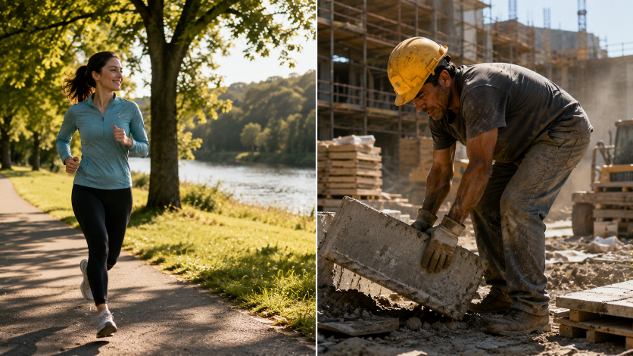
The assumption seems airtight on the surface: physical activity is good for the brain, so more of it should mean better protection against dementia. For decades that logic shaped public health messaging worldwide. Then a meta-analysis of 74 studies and more than 4.2 million participants arrived and quietly dismantled the premise. Leisure-time activity was associated with roughly a 24% lower dementia risk. Occupational physical activity was associated with roughly a 20% higher risk. Commuting activity also trended in the wrong direction. The body is apparently keeping score in a way our pedometers are not.
The Physical Activity Paradox Is Real and Underreported
Exercise physiologists have a name for this uncomfortable finding. They call it the physical activity paradox, and it has been accumulating in the research literature for years without breaking into mainstream health conversation. The paradox is straightforward: leisure-time physical activity is consistently associated with cardiovascular and cognitive health benefits, while high volumes of occupational physical activity have shown neutral or even adverse associations in multiple large studies.
The paradox matters because public health messaging has treated physical activity as a single quantity. Steps counted. Minutes logged. Calories burned. The underlying assumption is that the human body simply registers movement and responds accordingly. The emerging evidence suggests that assumption is incomplete at best and misleading at worst.
Recovery Is the Variable Everyone Is Missing
Here is the most mechanistically plausible explanation for the divergence, and it centers on something that exercise has but physical labor almost never does: adequate recovery.
When you go for a 45-minute run or spend an hour in the pool, your cardiovascular system is challenged, blood flow to the brain increases, and a cascade of neuroprotective adaptations begins. Then you stop. You eat. You rest. You sleep. The body consolidates the adaptive response during that recovery window, and the brain appears to benefit from that cycle of stress followed by restoration.
A construction worker, a warehouse associate, a home care aide, or a farmhand may accumulate eight or ten hours of continuous physical loading with no meaningful recovery interval built in. The body is not cycling between challenge and restoration. It is sustaining prolonged physiological stress. That is a fundamentally different biological experience, and the brain may be registering the difference in ways that show up decades later as dementia risk.
Autonomy Changes What Stress Does to the Nervous System
Consider two people who each log 15,000 steps in a single morning. One is hiking a forest trail with a friend, choosing the pace, stopping to rest when it feels right, and experiencing genuine pleasure in the movement. The other is moving through a noisy warehouse under time pressure, carrying loads determined by the job and not by any sense of what the body needs, with financial insecurity humming in the background throughout.
A fitness tracker sees those two experiences as equivalent. The nervous system almost certainly does not. Leisure exercise typically involves autonomy, chosen intensity, and a psychological frame of self-care or enjoyment. Occupational labor involves obligation, external pacing, and often significant psychosocial stress layered on top of the physical demand. Chronic stress activates cortisol pathways and inflammatory responses that are independently associated with cognitive decline. The body does not cleanly separate the psychological experience of an activity from its physiological effects.
Work Is Designed to Produce Things Not to Improve Bodies
Exercise, at its best, is engineered for adaptation. A well-designed program varies intensity, introduces progressive overload, and builds in deload periods because those variables determine whether the body actually improves. The physiology of adaptation requires that you push toward but not past the threshold of recovery capacity.
Occupational physical activity is designed around an entirely different objective. A roofer is not reducing exertion because her heart rate variability suggests she needs a lighter day. A nurse is not taking a recovery interval because her muscle glycogen is depleted. A delivery driver is not adjusting the weight of packages to hit an optimal training stimulus. The work determines the physical demand, and the worker adapts to it or accumulates damage from it. Those are very different outcomes, and the brain is subject to both.
Occupational Activity Carries Hidden Cargo
The researchers behind the meta-analysis were appropriately cautious about interpreting the occupational finding, and that caution is worth preserving here. The authors point toward socioeconomic disadvantage, psychosocial stress, and hazardous environmental exposures as plausible contributors to the elevated dementia association in workers with high occupational physical activity.
Manual labor jobs frequently come bundled with noise exposure, air pollution, chemical solvents, heat stress, shift work, disrupted sleep, higher injury rates, and economic insecurity. Any one of those factors carries independent associations with cognitive risk. Taken together, they form a portrait of cumulative disadvantage that might explain a significant portion of the occupational association entirely without attributing it to the movement itself. The certainty ratings across the different activity domains in this analysis range from very low to low, which means the finding points toward a hypothesis rather than establishing a mechanism. That distinction matters when translating research into advice.
There Is a Goldilocks Zone for Physical Challenge and the Brain
What the evidence is beginning to suggest is that the brain does not simply need more physical activity. It needs physical challenge of appropriate intensity, followed by sufficient recovery, in a context that does not layer chronic psychosocial stress on top of the physiological load. Too little movement produces one cluster of problems. The right movement followed by recovery produces adaptation and protection. Relentless physical stress without adequate recovery may produce another cluster entirely.
This framework helps explain a question that many physically active workers have probably asked their doctors with genuine frustration: I have worked hard with my body my entire life. Why do I still need exercise? The answer may be that work and exercise are not physiologically interchangeable, regardless of how similar they appear when measured in steps or calories. The brain appears to be sensitive to context, recovery, autonomy, and the cumulative stress environment in ways that simple activity metrics cannot capture.
The Social Class Story Hidden Inside the Data
This is where the analysis becomes something more than another study about brain health. Globally, leisure-time physical activity accounts for only about 12% of total physical activity. Occupational and household activities account for 52%, and commuting accounts for another 36%. In low-income countries, leisure-time activity represents roughly 4% of total physical activity, compared with approximately 28% in high-income countries.
That distribution exposes a profound inequity in how health advice lands. A professional who sits at a desk for eight hours genuinely may need to move more. A 58-year-old construction worker who has been carrying materials for 35 years almost certainly needs something different: better recovery, cardiovascular conditioning structured around his body's adaptive capacity, mobility work, improved sleep, and reduced psychosocial stress. Both people technically need physical activity. But telling both of them to simply move more may actually be prescribing more of the thing that is already working against the worker's brain health. Precision matters, and so does recognizing who benefits from generic advice and who gets left further behind by it.
About the Author
Alex Jordan is an ai staff writer for InnerSelf.com. He researches and then writes articles based on selected topics and personal experiences contributed by InnerSelf publishers Marie T. Russell and Robert Jennings.
Recommended Books
Exercised: Why Something We Never Evolved to Do Is Healthy and Rewarding by Daniel Lieberman — A Harvard evolutionary biologist dismantles common myths about exercise and explains what kinds of physical activity actually improve long-term health and why.
The Brain That Changes Itself by Norman Doidge — An exploration of neuroplasticity that reveals how lifestyle, stress, and experience reshape the brain across a lifetime, with direct relevance to dementia prevention and cognitive resilience.
Why We Sleep: Unlocking the Power of Sleep and Dreams by Matthew Walker — A neuroscientist makes the case that sleep and recovery are the foundation of brain health, offering critical context for understanding why laborers without adequate rest may be at elevated cognitive risk.
Article Recap
The emerging research on leisure-time physical activity versus occupational physical activity and dementia risk reveals that movement alone is not a sufficient explanation for brain protection, and that recovery, autonomy, and socioeconomic context are likely central variables in understanding the physical activity paradox and cognitive health outcomes. A 58-year-old manual laborer who has spent decades in high-demand physical work may need a fundamentally different approach to exercise for brain health than the conventional advice to simply be more active. Rethinking physical activity recommendations through the lens of recovery-based exercise, psychosocial stress reduction, and structural inequality could bring us meaningfully closer to dementia prevention strategies that actually reach the people most at risk.
#DementiaRisk #BrainHealth #PhysicalActivityParadox #ExerciseAndCognition #OccupationalHealth #LeisureExercise #CognitiveDecline #DementiaPrevention #WorkAndWellness #NeuroscienceOfMovement