







In This Article
- Why the coalition attempting to concentrate political power in America depends heavily on Donald Trump, and what happens when that vehicle becomes unreliable
- How the intellectual right, the policy right, and the populist right each bring something different to the table, and why Trump is the ingredient none of them can manufacture on their own
- What the intense battle over 2026 election machinery reveals about how confident the people running these efforts actually are
- Why billionaire geographic hedging is worth noticing, even if it does not prove anything sinister
- Why overwhelming democratic participation remains the one variable that money, technology, and executive power cannot fully predict or control
There is a clock running in American politics right now, and it is not the one most people are watching. Everyone is tracking the latest controversy, the polling averages, the war in Iran, the economy, and the November midterms. But underneath all that noise, another timer may be far more consequential.
A coalition of powerful interests that has never quite existed in this form before is working against a deadline it did not choose and cannot stop. That deadline has a name, a term limit, an actuarial table, and an election attached to it.
Donald Trump is 80 years old. He cannot constitutionally be elected president again. His popularity has fallen dramatically. Republicans face voters on November 3. And nobody knows whether Trump's extraordinary relationship with the MAGA movement can be transferred to a successor.
That leads to a possibility we should consider seriously.
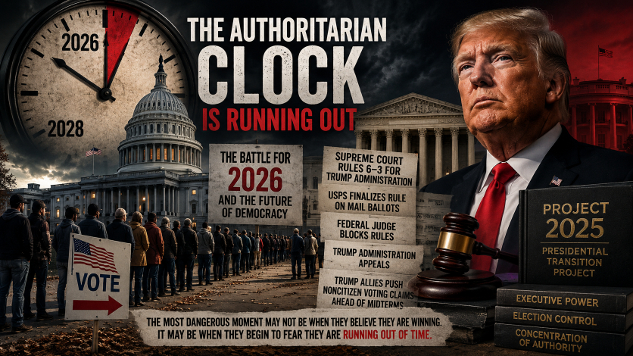
The most dangerous moment for American democracy may not come when those attempting to dismantle it believe they are winning. It may come when they begin to fear they are running out of time.
They Needed Someone Like Trump
Gil Durán's new book, The Nerd Reich: Silicon Valley Fascism and the War on Democracy, published on August 18, puts a name and a face on something that has been building for years in parts of Silicon Valley. Durán traces an intellectual current running through figures such as Peter Thiel and writer Curtis Yarvin that increasingly questions democracy itself.
The worldview is hardly secret. In 2009, Thiel wrote that he no longer believed freedom and democracy were compatible. Yarvin has spent years proposing alternatives to democratic government that resemble corporate management far more than representative government.
What this movement possesses is considerable: enormous wealth, technological infrastructure, political influence, control or influence over important communications platforms, and increasingly close connections to government. What it does not possess is a mass political following.
Ideas alone do not win elections. Billionaires don't fill arenas with working-class voters. A philosophy that questions democracy is unlikely to persuade millions of ordinary Americans to vote for less of it.
The Heritage Foundation and Project 2025 supplied something different. Heritage assembled a massive governing blueprint, developed a personnel operation, provided training, and created an implementation strategy intended to transform the federal government rapidly once a sympathetic president took office.
And implementation is no longer theoretical. One outside tracker reported in February that the Trump administration had initiated or completed 283 of 532 Project 2025 domestic administrative recommendations during its first year back in power.
But Heritage cannot generate a crowd. A think tank is not a movement. Trump can generate a crowd. He generates one almost the way certain musicians do, not primarily through policy papers but through personal identification. Millions of his supporters don't follow Trump because of Project 2025. Many probably couldn't identify Peter Thiel or Curtis Yarvin. They follow Trump because of their relationship with Trump. And that relationship is not necessarily transferable.
Trump also brings something the ideological and policy wings of this coalition cannot easily reproduce: a willingness to challenge institutional boundaries, test legal limits, attack opponents personally, and use presidential authority in ways conventional politicians might consider too politically or legally dangerous.
That combination , mass loyalty plus willingness to break political norms , may be the indispensable ingredient. Thiel's network didn't invent it. Heritage didn't invent it. They found it.
The Trump Problem
The problem is that Donald Trump cannot last forever. We don't need to diagnose his mental condition or speculate about his medical records to understand this. Age alone creates the problem. Trump turned 80 in June. The Twenty-Second Amendment prevents another elected presidential term. And the political clock may expire considerably sooner than January 2029.
The latest Reuters/Ipsos polling puts Trump's approval at just 33 percent, tied for the lowest level recorded during either of his presidencies. His approval has fallen from 47 percent when he returned to office in January 2025. Support for the Iran war has fallen as well, including among Republicans, while high gasoline prices and the cost of living have become serious political liabilities.
This matters because Trump doesn't have to lose the MAGA core to create a Republican electoral disaster. He merely has to lose enough independents, softer Republicans, occasional voters, and people who voted for him primarily because they believed he would lower prices or restore stability.
Republican leaders appear to understand the danger. Reuters reported this week that the party's unusual September midterm convention in Dallas is increasingly being viewed by officials and donors as a rescue mission intended to regain momentum before November.
Then comes the succession problem. JD Vance could inherit Trump's donors, organizational infrastructure, Heritage's personnel network, Silicon Valley allies, and perhaps Trump's endorsement. But nobody can guarantee that Vance inherits Trump's voters.
Ron DeSantis discovered the problem in 2023. Trumpism could be imitated. Trump could not. The coalition's greatest structural vulnerability may therefore be that its most important political resource cannot simply be passed from one candidate to another.
So Why Is Everyone Suddenly Fighting Over the Election?
If you want to understand how confident a political movement actually is about the future, don't listen only to what it says. Watch what it does with the machinery surrounding elections. And what is happening as the 2026 midterms approach deserves extraordinary attention.
On March 31, Trump issued an executive order attempting to impose new federal requirements on elections traditionally administered by the states. Among other provisions, it directed the Department of Homeland Security to create citizenship lists, authorized greater federal prosecution emphasis involving election officials, and instructed the Postal Service to establish new requirements governing mail ballots.
This week, that fight moved from theory to reality. On Monday, August 24, the Supreme Court's six-member conservative majority removed one judicial obstacle blocking portions of Trump's order. Importantly, the Court did not decide that Trump's actions were constitutional. It ruled that the states challenging the order had sued prematurely.
The Court itself emphasized that its decision did not mean whatever the administration subsequently did would necessarily be lawful. The three liberal justices dissented. Then the Postal Service finalized its rules.
Under the new system, states would have to provide lists of eligible voters and comply with new federal ballot-envelope and barcode requirements. The Postal Service could refuse to transmit ballots that failed to satisfy those requirements.
This isn't a theoretical change proposed for 2028. The first general-election mail ballots are scheduled to go out September 4. Nearly one-third of American voters are expected to vote by mail.
On Thursday, federal Judge Indira Talwani blocked implementation for two weeks, finding that states simply lacked sufficient time and resources to redesign ballots, modify election systems, train officials and comply with the new requirements before voting begins. On Friday, the Trump administration appealed. The fight could be back before the Supreme Court within days.
And today, another part of the picture is emerging. Trump and his allies are escalating allegations that noncitizens may participate illegally in November's election. The Department of Homeland Security has claimed that as many as 250,000 noncitizens might be registered in four states without publicly providing evidence establishing that number.
Election officials themselves have questioned the figures. Pennsylvania's Republican secretary of the commonwealth reported that federal officials acknowledged they did not have high confidence that more than 14,000 people initially identified there were actually improperly registered noncitizens.
Meanwhile, Trump continues pushing Congress for documentary proof-of-citizenship requirements. And in Maine, the Republican candidate for governor was recorded discussing bringing U.S. marshals and ICE agents to polling places.
These are not random bureaucratic developments. The administration is openly pursuing changes to election administration and openly defending those changes in court. What remains an inference is the ultimate political purpose.
So ask the obvious question. Why is an administration sitting at roughly 33 percent approval, facing a potentially devastating midterm election, simultaneously attempting to exercise greater federal influence over who receives mail ballots, voter citizenship verification, election officials, and other mechanisms surrounding that election?
Perhaps there are separate explanations for every action. But at some point, the pattern itself becomes the story.
What If They Know They Could Lose?
This brings us back to Peter Thiel.
Thiel has long possessed New Zealand citizenship. More recently, he bought a mansion in Buenos Aires, temporarily moved his family there, developed a relationship with Argentine President Javier Milei, and this month disclosed a roughly $76 million investment through his hedge fund in one of Argentina's largest oil producers. Argentina is becoming attractive to other wealthy technology figures as well. Some are explicitly developing what amounts to geopolitical catastrophe insurance there.
Larry Ellison presents a different example. The Oracle co-founder owns roughly 98 percent of Lānaʻi in Hawaii, an extraordinary concentration of private ownership over an inhabited American island.
We should be careful here. None of this proves that Thiel, Ellison, or other billionaires are preparing to flee because they expect the American people to reject their political preferences. But it illustrates an important asymmetry.
Extremely wealthy people can hedge political risk in ways ordinary Americans cannot. They can maintain residences in multiple jurisdictions. They can obtain additional citizenships. They can distribute investments internationally. They can move themselves and their families.
Most Americans are all-in on America. Their homes are here. Their retirement is here. Their children and grandchildren are here. Their communities are here. Their Social Security is here. Their future is here. If America's democratic experiment fails, most Americans don't have a second country waiting in the wings.
The Variable They Cannot Control
There is still something all the money, technology, executive authority, political planning and legal maneuvering cannot guarantee. What millions of Americans will do when they vote.
In fact, the intensity of the fight over election administration may tell us something surprisingly hopeful. If elections no longer mattered, why fight so hard over them? If the outcome were already guaranteed, why impose new mail-ballot requirements weeks before voting begins? Why fight over citizenship lists? Why appeal immediately when a federal judge blocks the rules? Why continue pushing Congress to change voter-registration requirements?
Elections matter precisely because their outcomes remain uncertain. And the margin matters. A razor-thin election creates opportunities for recounts, ballot challenges, certification disputes, litigation, and arguments over legitimacy. When a few thousand votes determine control, almost every procedural dispute becomes potentially consequential.
An overwhelming vote changes the equation. It does not eliminate voter suppression. It doesn't prevent litigation. It doesn't guarantee that every political actor accepts the result. But it makes changing the outcome enormously more difficult.
You can challenge thousands of ballots. It becomes considerably harder to explain away millions of voters. This is not an argument that American democracy is already lost. It is almost the opposite.
The extraordinary effort now being directed toward the machinery surrounding elections suggests that elections remain capable of disrupting whatever longer-term transformation is being attempted.
Which Clock Reaches Zero First?
Two clocks are now running simultaneously. The first belongs to the coalition attempting to consolidate political power. Trump is 80. His approval has fallen to 33 percent. The November midterms are approaching. Republicans hold narrow congressional majorities. And beyond all of that sits the unresolved question of 2028: Who can replace Trump?
The second clock belongs to American democracy. Executive authority continues expanding. Institutional boundaries continue being tested. Election administration has become an arena of direct presidential intervention. Court decisions can remove restraints even when they do not ultimately decide the constitutional questions involved. Conduct that once would have produced political shock gradually becomes normalized simply because Americans see it repeatedly.
That is why the next few months may be more dangerous than a period in which Trump's power appeared secure. If Trump represents an unusual political opportunity for people who want to fundamentally restructure American government, then his weakening political position doesn't necessarily cause them to retreat.
It could produce exactly the opposite response. Move faster. Use the authority while it exists. Change whatever can be changed before Congress changes hands. Secure whatever advantages can be secured before voters have their say. That does not require a secret meeting or a single conspiracy.
Heritage can pursue its objectives. Technology billionaires can pursue theirs. Trump can pursue his. Republican politicians can pursue reelection. Supreme Court justices can reach decisions according to their own constitutional philosophies. Different motives can nevertheless push power in the same direction.
And that brings us back to the clock. Heritage can write the plans. Thiel's political network can provide money, technology and intellectual infrastructure. The Supreme Court majority can remove some institutional restraints. Loyalists throughout the executive branch can implement presidential directives.
But Trump supplies something none of them can manufacture. Millions of Americans willing to give him political power. And those same Americans , together with millions more who increasingly oppose him , remain the variable nobody controls.
The most dangerous period for American democracy may therefore not be when those threatening it believe they have already won. It may be when they begin to suspect they might lose. Because a movement that believes its window is closing has every incentive to reach harder and faster for the levers it still controls. That reaching is what Americans should be watching now.
And democracy's most powerful response remains remarkably simple: people showing up in numbers too large to suppress, too large to explain away, and too large to plausibly dispute.
About the Author
 Robert Jennings is the co-publisher of InnerSelf.com, a platform dedicated to empowering individuals and fostering a more connected, equitable world. A veteran of the U.S. Marine Corps and the U.S. Army, Robert draws on diverse life experience, from real estate and construction to building InnerSelf.com with his wife, Marie T. Russell, bringing a practical, grounded perspective to life's challenges. InnerSelf grew from InnerSelf Magazine, founded by Marie T. Russell in 1985, which became InnerSelf.com in 1996. Decades later, InnerSelf continues to inspire clarity and empowerment.
This article is licensed under a Creative Commons Attribution-NonCommercial-NoDerivatives 4.0 License. You may share it with attribution to Robert Jennings, InnerSelf.com, and a link back to the original article at InnerSelf.com. Commercial use and derivative works are not permitted without permission.
Recommended Books
The Nerd Reich: Peter Thiel, Curtis Yarvin, and the Techno-Authoritarian Movement by Gil Duran , A documented examination of the intellectual framework behind Silicon Valley's anti-democratic turn and its connections to the current political moment.
How Democracies Die by Steven Levitsky and Daniel Ziblatt , A comparative political science study of how elected governments across history have dismantled democratic institutions from within, with direct relevance to the American situation.
Twilight of Democracy: The Seductive Lure of Authoritarianism by Anne Applebaum , A personal and analytical account of why intellectuals and elites in multiple countries have abandoned democratic commitments in favor of authoritarian political arrangements.
Article Recap
The coalition attempting to concentrate political power in the United States faces a closing window tied directly to Donald Trump's age, declining approval ratings, and the unavoidable 2026 midterm elections, which may explain the accelerating effort to influence election administration, voter registration rules, and the legal machinery surrounding democratic participation. The intense battle over election rules and the mechanisms surrounding the 2026 midterms suggests that those driving these changes are not certain they can win elections conducted under fair and stable conditions. The one variable that money, technology, executive authority, and policy infrastructure cannot predict or control remains the American electorate, and overwhelming democratic participation continues to be the most consequential force available to ordinary citizens who, unlike certain billionaires, cannot hedge their stake in America's future across international jurisdictions.
#AuthoritarianClock #Project2025 #TrumpSuccession #2026Midterms #AmericanDemocracy #ElectionIntegrity #PeterThiel #HeritageFoundation #VotingRights #DemocraticParticipation