






In This Article
- Why the feeling that something is deeply wrong isn't paranoia but pattern recognition
- How agriculture accidentally invented hierarchy and what "inbreeding" really means at a civilizational scale
- Why the Black Death did more for human freedom than most revolutions
- How individualism, civilization's greatest cure, became its next disease
- What interdependence looks like as a practical organizing principle rather than a bumper sticker
You don't need a political science degree to sense that the machinery isn't working right. Politics drifts toward authoritarian habits and oligarchic arrangements even in countries with long democratic traditions. Communities thin out. Inequality widens to proportions that would have embarrassed a medieval baron. And the ecological systems that underpin everything else quietly deteriorate while the people best positioned to act argue about whether they exist. These aren't separate problems that happened to arrive at the same time. They share a root, and that root is old.
Farming Built the First Cage
For most of human history, you couldn't accumulate much because you couldn't store much. Hunter-gatherer bands moved, and mobility is the enemy of hoarding. Then agriculture arrived, and everything changed. Farming produced surplus. Surplus meant you could own more than you could eat today. And once you could own more than you could eat today, someone was going to figure out how to make sure they owned more than everyone else.
Land became property. Property passed to heirs. Heirs passed it to their heirs. Wealth concentrated. Power followed wealth. Occupations became inherited. Ideas became the property of priesthoods. Opportunity arranged itself around bloodlines, and the arrangement hardened over generations into something that felt as natural as the seasons.
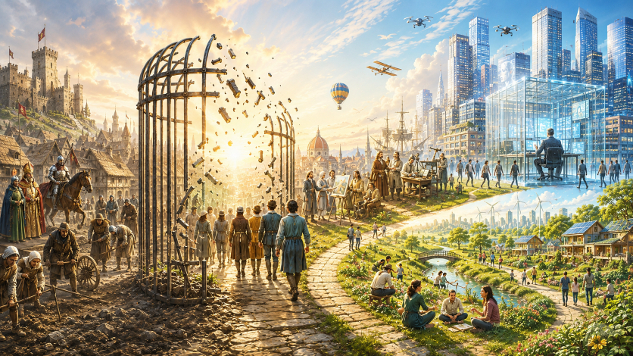
Here is a broader and more useful definition of "inbreeding" than the biological one: a society becomes inbred when it closes itself into a system where the same families, classes, ideas, and concentrations of authority continually reproduce themselves. The gene pool of power stops mixing. European feudalism is the clearest example in the Western tradition, but the pattern appears wherever surplus allows hierarchy to calcify. Lord, serf, priest, and merchant. Your grandfather's position is your position. The cage isn't iron. It's inheritance.
The Black Death Accidentally Opens the Cage
In the middle of the fourteenth century, a plague arrived in Europe and killed somewhere between a third and half of the population within a few years. It was a catastrophe of a scale that is genuinely difficult to imagine. Villages emptied. Entire family lines ended. The psychological damage was staggering, and the theological damage wasn't far behind, because if God allowed this, what exactly was the church selling?
But the land remained. The fields were still there. The tools were still there. The animals were still there. And suddenly, there weren't enough people to work any of it.
That scarcity of labor did something that centuries of peasant revolts had failed to do. It gave ordinary people bargaining power. If Lord Somebody wanted his fields harvested, he was going to have to offer something worth a laborer's time, because that laborer could walk down the road and find three other lords who needed workers just as badly. Wages rose. Serfs drifted toward towns. Feudal obligations became harder to enforce when the people obligated to them had options.
Follow the thread forward and the compressed historical trajectory looks something like this: the Black Death weakens feudal relationships, which creates greater mobility and bargaining power, which changes economic relationships, which funds and enables a Renaissance of art, science, and classical learning, which cracks open theological monopolies and produces the Reformation, which liberates inquiry and accelerates the Scientific Revolution, which generates the Enlightenment's insistence that reason rather than birth determines truth, which produces liberalism, individual rights, democracy, and market capitalism.
That chain is not a simple cause-and-effect argument. History doesn't move in straight lines, and a lot of people suffered terribly at every stage of it. But the central mechanism is real: when a previously closed system is cracked open, human possibility tends to rush through the gap. The plague was the crowbar. Nobody planned it that way. Cures rarely arrive on schedule.
Individualism Worked and Perhaps Too Well
Give the Enlightenment its due, because it deserves it. The proposition that individual human beings have inherent rights that no king, priest, or tradition can legitimately cancel was genuinely revolutionary. It took centuries of argument, war, and hard political work to make it stick even partially, and it still isn't fully settled in most of the world.
What came from that proposition is worth naming plainly. Scientific inquiry freed from ecclesiastical veto. Religious conscience protected from state enforcement. Democratic accountability for those who hold power. Entrepreneurship as a path that doesn't require noble blood. Markets that could, at their best, reward competence over connection. Social mobility that made a person's starting point less determinative of their ending point. The individual escaping inherited authority is one of civilization's genuinely great accomplishments. Don't let anyone use what comes next to obscure that.
But a cure can become destructive when you keep increasing the dose after the disease has changed. Individual freedom is the antidote to feudal closed systems. Individual freedom is also, at some threshold, a solvent that begins dissolving the collective structures that make freedom possible in the first place. Individual freedom becomes individualism. Individualism becomes the philosophical premise that the self is the only unit that ultimately matters. And at that point you're not treating a disease anymore. You're creating a new one.
The Sovereign Individual and the Tech Elite
The extreme version of individualism running through contemporary politics and Silicon Valley culture says something coherent and internally consistent, which is part of what makes it worth taking seriously. It says: my success belongs entirely to me, government constrains me, taxation takes from me, regulation interferes with me, and society's claims upon me are coercive rather than legitimate.
The contradiction, though, is right there in the open if you're willing to look at it. The supposedly sovereign billionaire built his fortune on science funded by public institutions, educated in universities built on public land grants, moving products over infrastructure paid for by collective taxes, protected by legal systems enforced by governments, trading in currencies backed by state authority, communicating over networks built on publicly developed protocols, and drawing on centuries of accumulated knowledge that nobody alive invented or paid for.
Nobody is self-made because nobody is self-sustaining. The sovereign individual is a useful fiction, and like most useful fictions, it tends to be most popular among the people it flatters most directly.
Here is the historical irony that should give everyone pause. The philosophy that helped dismantle inherited concentrations of feudal power, the Enlightenment insistence on individual liberty against collective authority, is now being deployed to dismantle the democratic institutions and collective restraints that prevent new concentrations of power from forming. The people invoking freedom from government most loudly are frequently the people best positioned to fill the space that government vacates. The cage isn't being abolished. It's being rebuilt with updated materials. New families, new wealth, new inherited advantage, same basic architecture.
We Left Half the Human Toolkit Behind
Civilization, as it accelerated through the industrial and post-industrial eras, made a consistent set of choices about which human capacities to reward. Competition got rewarded. Production got rewarded. Expansion, accumulation, and control got rewarded. The activities that don't produce a quarterly return, care, maintenance, cooperation, replenishment, and regeneration, got treated as background conditions rather than economic contributions.
Historically, and this is not a coincidence, the undervalued activities were disproportionately performed by women. The argument here isn't that women are morally superior to men or that female leadership would have produced a paradise. That argument, however satisfying it might feel, just constructs a different cage. The stronger argument is this: a civilization that excludes either half of humanity's perspectives and lived experience becomes another closed system. It inbreeds. It reproduces the same assumptions across generations because the people challenging those assumptions aren't in the room.
Escaping male domination cannot mean constructing female domination, just as escaping feudal collective domination cannot mean destroying collective responsibility altogether. The pattern of the cage doesn't care what ideology it uses. It just needs a closed system and enough time. History keeps handing us variations on the same exam, and we keep writing the same wrong answer with new vocabulary.
The Next Step Is Interdependence
The historical progression of human social organization has moved in a recognizable direction even if it hasn't moved in a straight line. Feudal dependence came first, where your fate was determined entirely by the position you were born into and the authority of those above you. Enlightenment independence came next, where the individual acquired rights, mobility, and the theoretical capacity to determine their own fate. Both of those stages represented real progress over what came before.
But independence, taken as a terminal destination rather than a stage in a longer journey, produces the contradictions we're living through now. The next stage isn't a retreat from independence. It's the recognition of something that was always true but that the Enlightenment framework made it temporarily useful to underemphasize: everything you do as an individual depends upon systems that must continually be replenished.
Call it regenerative interdependence, or just interdependence. The name matters less than the underlying shift in how we measure success. An economy that asks only how much we produced is like a farmer who measures only yield while never measuring soil health. Eventually the yield question answers itself, badly. A regenerative economy asks whether the act of producing left the systems that make future production possible stronger or weaker. Those systems include people, families, communities, infrastructure, democratic institutions, soil, water, climate, and ecosystems. They include the invisible maintenance work that keeps social fabric from tearing. They include the unglamorous institutional labor that keeps democracy from becoming a slogan.
Keep individual rights. Keep democracy. Keep entrepreneurship and markets where they actually serve human flourishing rather than replace it. Keep scientific freedom and individual creativity and everything else the Enlightenment earned through hard argument and harder struggle. But stop pretending those achievements float free of the systems that make them possible. Regeneration isn't anti-freedom. It's what freedom requires to survive past the first generation.
Completing What the Enlightenment Started
Return to that feeling at the opening, the one that something isn't working even though by most measurable standards we are extraordinarily wealthy and technically capable. Perhaps that feeling is pattern recognition rather than pessimism. Perhaps we're sensing the limits of an organizing philosophy that accomplished something remarkable and then kept running on its own momentum past the point where it was solving problems and into the territory where it was creating them.
The Enlightenment delivered one revolutionary insight: the individual matters. That was not obvious before, and it still isn't guaranteed in most of the world. The next step doesn't repeal that discovery. It completes it. The individual matters, and so does everything that makes the individual possible. Humanity spent several centuries learning how to free the individual from inherited cages of class, church, and crown. The work now is learning how free individuals can live together without dismantling the human, social, and natural systems that make their freedom possible in the first place. That isn't a retreat from the Enlightenment. It's the sequel it always needed.
Musical Moment
About the Author
 Robert Jennings is the co-publisher of InnerSelf.com, a platform dedicated to empowering individuals and fostering a more connected, equitable world. A veteran of the U.S. Marine Corps and the U.S. Army, Robert draws on diverse life experience, from real estate and construction to building InnerSelf.com with his wife, Marie T. Russell, bringing a practical, grounded perspective to life's challenges. InnerSelf grew from InnerSelf Magazine, founded by Marie T. Russell in 1985, which became InnerSelf.com in 1996. Decades later, InnerSelf continues to inspire clarity and empowerment.
This article is licensed under a Creative Commons Attribution-NonCommercial-NoDerivatives 4.0 License. You may share it with attribution to Robert Jennings, InnerSelf.com, and a link back to the original article at InnerSelf.com. Commercial use and derivative works are not permitted without permission.
Recommended Books
The Dawn of Everything: A New History of Humanity by David Graeber and David Wengrow — a sweeping revisionist history that challenges the standard story of how human societies moved from freedom to hierarchy, drawing on archaeology and anthropology to show that the path was far more varied and reversible than we assumed.
The Enlightenment Now: The Case for Reason, Science, Humanism, and Progress by Steven Pinker — a rigorous and data-rich defense of Enlightenment values and the genuine progress they produced, essential reading for anyone who wants to celebrate what modernity accomplished before critiquing where it stalled.
Doughnut Economics: Seven Ways to Think Like a 21st-Century Economist by Kate Raworth — a clear and persuasive argument for replacing growth as civilization's organizing metric with a framework that measures whether human needs are met within the ecological boundaries that make continued life possible.
Article Recap
The overlapping crises of rising authoritarianism, extreme wealth concentration, weakening communities, and environmental deterioration share a common historical root in closed systems that concentrate power and exclude renewal. Understanding the arc from feudal dependence through Enlightenment independence toward regenerative interdependence helps explain why hyper-individualism, despite its liberating origins, is now rebuilding the hierarchical cages it once helped dismantle. The path forward preserves individual rights and democratic freedoms while recognizing that long-term human flourishing depends on replenishing the social, ecological, and institutional systems that make freedom possible.
#RegenerativeEconomics #HyperIndividualism #EnlightenmentValues #Feudalism #BlackDeath #DemocraticErosion #WealthInequality #Interdependence #SystemsThinking #HumanProgress